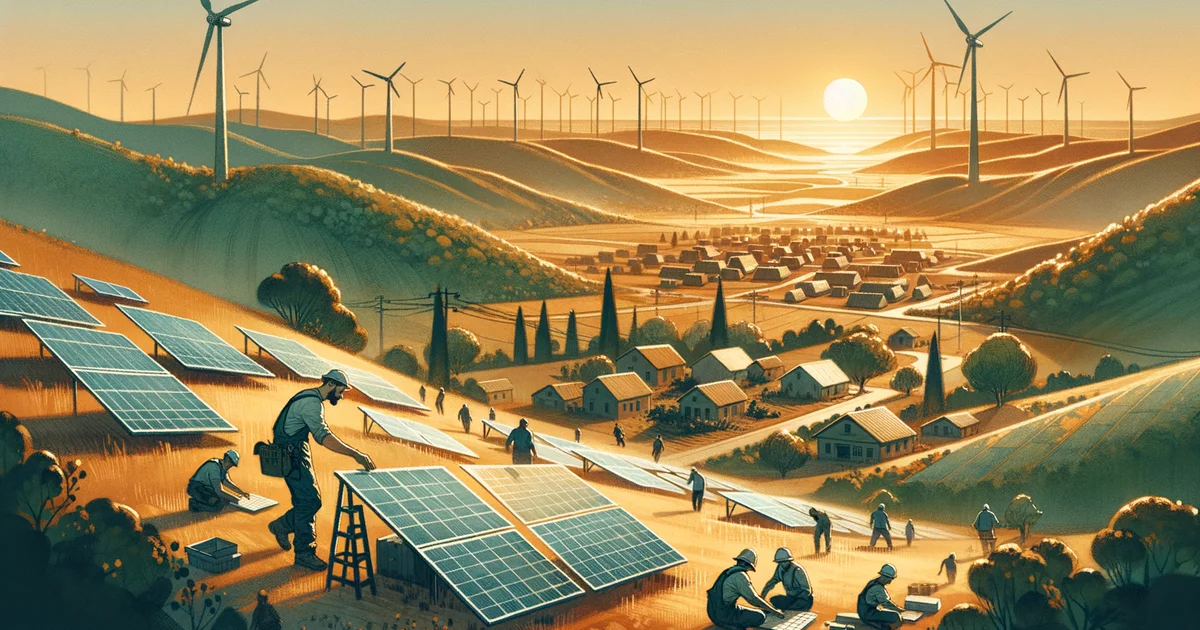
The Energy Transition: The Curve That Changes Everything
In 2010, solar electricity cost 414% more than fossil fuels. In 2023, it costs 56% less. This reversal, documented by IRENA, is the most important economic fact of the decade — and one of the least known.
The Energy Transition: The Curve That Changes Everything
TL;DR — In 2010, solar electricity cost 414% more than fossil alternatives. In 2023, it costs 56% less. This reversal, documented by the International Renewable Energy Agency, is the most important economic fact of the decade — and one of the least known. This is not about energy policy. It is about an industrial learning curve following its trajectory, independent of governments.
The Statistic That Should Have Made Every Front Page
In 2009, producing one megawatt-hour of solar electricity cost $496. It was a luxury reserved for California rooftops and pocket calculators. Energy experts regarded it as a niche technology — expensive, subsidy-dependent, incapable of competing with coal or gas at scale.
Fifteen years later, according to Our World in Data, that price has fallen by 88%.
But the most striking figure is not the absolute decline. It is what it means for competitiveness: solar electricity in 2023 now costs 56% less than the weighted average of fossil alternatives. In 2010, it was 414% more expensive. This complete reversal — from a prohibitive technology to the cheapest source of electricity in industrial history — happened within a single generation.
According to IRENA (the International Renewable Energy Agency), onshore wind follows the same trajectory: the global average cost of onshore wind is today 67% lower than fossil fuel alternatives.
These figures do not come from an advocacy think tank. They come from the intergovernmental organisation mandated to track real energy costs across 132 countries.
Wright’s Law: Why This Decline Was Predictable
In 1936, aeronautical engineer Theodore Wright observed something strange in aircraft factories: every time cumulative production doubled, manufacturing costs fell by a constant percentage. He published his observation. It became known as Wright’s Law.
What energy economists took time to understand is that solar panels and wind turbines follow exactly this law. As Our World in Data explains: “the fundamental driver of this change is that renewable energy technologies follow learning curves, which means that with each doubling of cumulative installed capacity, their price falls by the same fraction.”
This is not magic. It is industrial engineering: the more panels you manufacture, the more production lines optimise, the more material costs fall, the more yields improve. Fossil fuels, by contrast, follow no learning curve. Coal extracted in 2024 does not cost less than coal extracted in 2010 — sometimes it costs more, as the most accessible deposits are exhausted.
What makes this curve so powerful is that it is predictable. The 2015 models that projected grid parity for 2030 were overtaken by a reality that arrived ten years ahead of schedule. The same models, recalibrated, suggest the trajectory is far from over.
Where Things Stand in 2024
The 2023 figures documented by IRENA show a scale that is difficult to visualise:
- Total global renewable capacity reached 3,870 gigawatts — equivalent to roughly 3,870 standard-sized nuclear power plants operating in parallel.
- In 2023, 86% of all new electrical capacity installed worldwide was renewable.
- Solar alone added 345.5 GW in a single year — an absolute record — and now represents 73% of annual global renewable growth, for a total installed capacity of 1,419 GW.
To put these figures in perspective: fifteen years ago, according to Our World in Data, solar was still more than three times more expensive than coal — a niche technology reserved for a few rooftops and satellites. The learning curve did the rest.
According to IRENA, “the only technology available to accelerate the energy transition in line with the Paris Agreement objectives” is the one now producing 86% of new installations. This is no longer a future transition. It is a transition underway.
What This Means for Global Energy Bills
The same IRENA publication estimates that renewable capacity added since 2000 reduced global electricity sector fuel costs in 2023 by at least $409 billion. These savings are not projections. They are realised, now, in the accounts of grid operators around the world.
What This Changes, Concretely
Energy Access in the Global South
The solar learning curve is not only good news for wealthy countries. It is transformative for countries that have never had access to a reliable electricity grid.
Building a coal or gas plant requires heavy infrastructure, long-term supply contracts, and transmission networks. An isolated village in sub-Saharan Africa or South-East Asia can today install solar panels and battery storage at a cost lower than extending the conventional grid — and without depending on fuel imports.
This decentralised energy shift is already underway. It accelerates with falling prices.
Energy Security
Russia’s invasion of Ukraine in 2022 reminded Europe what it means to depend on imported fossil fuels: geopolitical vulnerability, volatile prices, and the capacity for coercion. Solar and wind have a fundamental advantage: no one can impose an embargo on wind or confiscate the sun. Renewable energy is, by nature, a domestic resource.
Honest Obstacles
It would be misleading to present this transition as a frictionless curve. The obstacles are real.
Intermittency and Storage
The sun does not shine at night. The wind does not always blow. This intermittency is the structural challenge of renewables — and it is a serious one. An electrical system cannot function with variable sources without storage or balancing mechanisms.
The good news — and here is where the learning curve becomes relevant again — is that storage batteries follow the same trajectory. According to IRENA, the cost of battery storage projects fell by 89% between 2010 and 2023. The same dynamic that made solar competitive is now making large-scale storage accessible.
Smart grids, demand-side management, green hydrogen as a seasonal storage vector, cross-border interconnection — none of these solutions is sufficient alone, but their combination constitutes a credible response. The engineers working on this problem do not see it as a dead end. They see it as an engineering problem — difficult, expensive, but solvable.
Critical Minerals
Batteries, wind turbine magnets, and solar grid cabling require lithium, cobalt, copper, and rare earths. These resources are geographically concentrated — notably in the Democratic Republic of Congo for cobalt, in Chile and Australia for lithium. Their extraction has documented environmental and human impacts, and risks recreating a form of geopolitical dependency.
This is not an argument against the transition. It is an argument for designing it rigorously: investing in end-of-life battery recycling, developing battery chemistries less dependent on cobalt, diversifying supply sources, and enforcing social standards in extraction chains. These problems are real and deserve more attention than they currently receive.
Mining Regions and Fossil Fuel Workers
Every transition has short-term losers. Coal miners in Poland, the Ruhr, or Appalachia do not automatically benefit from job creation in renewable energy — which is often located elsewhere and requires different skills. Ignoring this social cost would be both a moral failure and a political error: it is precisely this cost that fuels the backlash against climate policies.
A just transition requires active retraining policies, support for territories in mutation, and genuine listening to those who see their way of life under threat. These words are easy. The policies that translate them into reality are difficult and expensive. But they are the price of the social consensus without which no transition is durable.
What Is Plausible by 2035
This section is an illustrative extrapolation, not a scientific forecast. Past trajectories do not guarantee future trajectories.
If solar and wind learning curves continue at their documented rate from the past fifteen years, and if global deployment continues on a trajectory similar to 2023, renewables could represent the majority of global electricity production before 2035. Several models — including those of the International Energy Agency — place this tipping point in the first half of the 2030s.
This is not a utopian projection. It is the straightforward extrapolation of a documented trend — like predicting that the next smartphone will have more computing power than the previous one. The curve could slow. It could accelerate. But nothing in current dynamics suggests it will reverse.
What is certain: the 2010 experts who placed solar parity at 2040 were wrong by twenty years. Epistemic caution in this domain argues for not underestimating the trajectory.
What You Can Do Now
The energy transition does not wait for governments to agree. It is happening, at varying speeds, in the choices that millions of people and organisations make every day.
If you are an individual:
- Choosing an electricity supplier that purchases renewable energy changes the market signal, even at small scale.
- Consider rooftop solar for self-consumption — whose cost has fallen at the same pace as the industrial LCOE.
- Support candidates and policies that accelerate permitting procedures for renewables — one of the real bottlenecks in Europe.
If you work in an organisation:
- Purchasing certified green electricity (Power Purchase Agreements) has become an economically rational decision, not merely an ethical one.
- Thermal retrofitting, combined with electric heating, links two transitions that reinforce each other.
If you want to understand:
- Follow IRENA’s annual cost publications — they are free, sourced, and regularly debunk pessimistic narratives.
The curve is turning. It has been turning for fifteen years, faster than predicted. The question is no longer whether renewables can replace fossil fuels. The question is how quickly we choose to make it happen.
Sources
- IRENA — Renewable Power Generation Costs in 2023 — verified 2026-05-02
- IRENA — Record Growth in Renewables, but Progress Needs to be Equitable — verified 2026-05-02
- Our World in Data — Why did renewables become so cheap so fast? — verified 2026-05-02
See also:
Pass it on
If this article resonated with you, share it with someone around you. In a world where bad news travels fast, it is just as valuable to spread what is going well. Passing on something inspiring is already a form of action.
Comments
Leave a comment
Did this article inspire a thought, a question, or a reaction? Share it below — all comments are reviewed before publication.


