The Ocean is Regenerating: The Numbers Nobody Cites
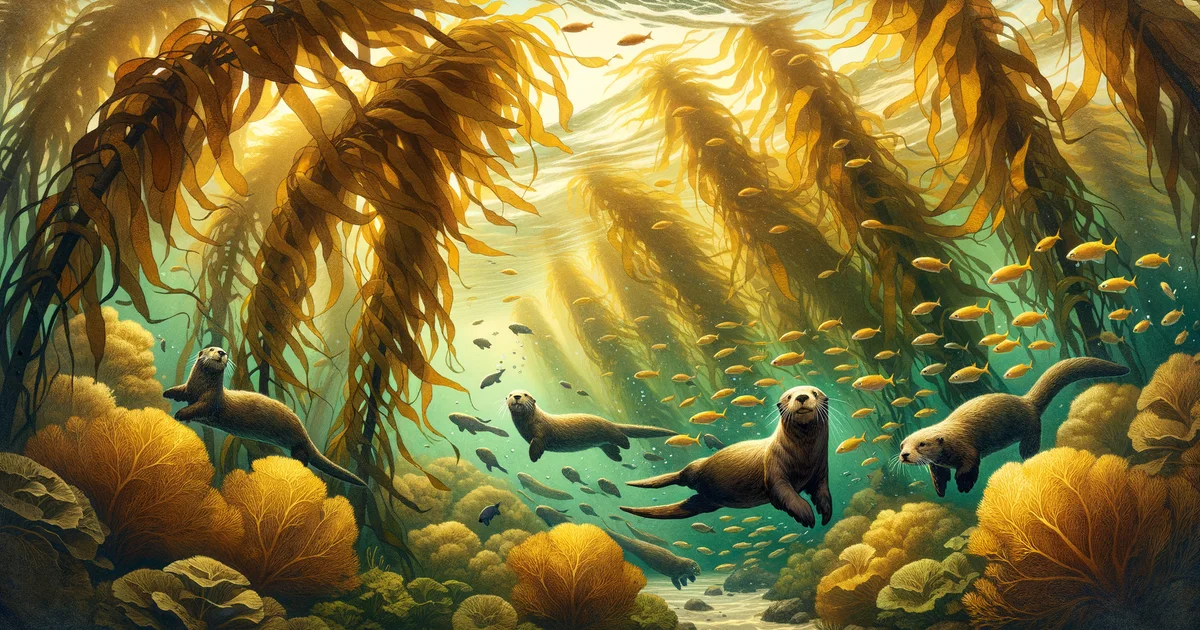
Inside fully protected marine reserves, fish biomass is 670% higher than in unprotected areas. Off California, the return of sea otters increased carbon storage in kelp forests by 5.3%. The ocean recovers — fast, sometimes spectacularly — when given the chance.
The Ocean is Regenerating: The Numbers Nobody Cites
TL;DR: The dominant narrative on oceans is one of inexorable decline. The data tells a more complex story: inside fully protected marine reserves, where fishing is strictly banned, fish biomass is on average 670% higher than in unprotected areas. Off the California coast, the return of sea otters increased carbon storage in kelp forests by 5.3%. The crisis is real. But the ocean recovers — fast, sometimes spectacularly — when given the chance. The problem isn’t biological. It’s political.
Imagine two seafloors a few kilometres apart. In the first, decades of trawling have scraped the bottom clean, leaving a near-desert — sparse species, silence. In the second — a marine reserve where fishing has been banned for twenty years — dense schools of fish, sizeable groupers, a canopy of underwater vegetation visible from the surface.
This contrast is not hypothetical. It exists, documented, measured, reproducible across marine ecosystems around the world.
And yet the numbers that describe it rarely circulate.
The figure nobody cites
In 2017, marine biologists Enric Sala and Sylvaine Giakoumi published a meta-analysis in the ICES Journal of Marine Science, one of the leading journals in fisheries science. After compiling data from marine reserves worldwide, their conclusion was unambiguous:
“The biomass of the entire fish assemblage was, on average, 670% greater in marine reserves than in unprotected areas.”
Six hundred and seventy percent. That is not a marginal improvement. It is an ecosystem transformation.
The same meta-analysis also found that even partially protected areas — where some fishing activities remain permitted — show biomass 343% higher than areas with no protection at all. The signal is robust and consistent across different latitudes, climate regimes, and ecosystem types.
This figure rarely makes headlines. The dominant media narrative remains one of catastrophe: stocks collapsing, corals bleaching, plastics everywhere. That isn’t wrong. But this incomplete framing carries a real cost: it discourages action precisely where it would be most effective.
The crisis is real. And precisely located.
Before going further: this article does not minimise the ocean crisis. It is documented, serious, and multifaceted.
Overfishing has emptied entire regions of their apex predators — sharks, tuna, swordfish. Ocean acidification, a direct consequence of CO₂ absorption from the atmosphere, weakens the calcified shells of molluscs and the skeletons of corals. Warming surface waters trigger increasingly frequent and intense coral bleaching events. Coastal pollution creates dead zones at river mouths.
These realities are incontestable. They do not disappear because marine reserves work well elsewhere.
What the data does show, however, is that degradation is largely the result of direct, geographically localised, and by definition stoppable human pressures. Where those pressures cease — even partially, even temporarily — life returns. Often quickly. Sometimes spectacularly.
The distinction matters: acidification is a global problem requiring a systemic response on CO₂ emissions. Overfishing is a localised problem addressed through management decisions. Conflating the two risks a sense of powerlessness in the face of everything, when effective action is possible on part of it.
What happens when you stop fishing
The mechanism is straightforward in principle: remove fishing pressure from an area, and target-species populations rebuild. Apex predators return. The food web reorganises. Biodiversity increases.
In practice, Sala and Giakoumi identified the conditions that make reserves effective. No-take zones — areas of total exclusion — are by far the best performers. Their effectiveness grows with age, area, geographic isolation from adjacent fishing zones, and the rigour of enforcement.
Age matters above all: the most striking effects appear after ten to fifteen years of strict protection. Long-lived species — large marine predators — take time to rebuild. But when they return, they alter the entire ecosystem.
This is exactly what terrestrial ecology learned from rewilding: ecosystems are not stocks of resources to manage, but networks of interactions. Remove a keystone species and you alter the whole network. Allow it to return — or simply stop removing it — and you can trigger cascade effects nobody anticipated.
The otter, architect of marine forests
The most striking illustration of this principle plays out ten metres below the surface, off the California coast.
Sea otters (Enhydra lutris) were hunted to near-extinction for their fur between the eighteenth century and the early twentieth. Their Californian population gradually recovered from the 1970s onward, thanks to federal protection programmes. And that recovery produced an effect nobody expected at this scale.
Sea otters eat sea urchins. Sea urchins in excess — freed from any predator — graze kelp forests down to bare rock. Kelp, the large brown algae that form one of the most productive marine ecosystems on the planet, disappears entirely. With otters, urchins are kept in check. Kelp recovers.
In 2024, a research team quantified this effect using historical California data, in a study published in PLOS Climate: in areas of central California where otter density is highest, kelp cover is 57.6% greater than it would be without their presence. And that kelp recovery has a direct climate implication: carbon storage in Californian kelp forests increased by 5.3%, from 556.5 to 586.0 kilotonnes of CO₂ equivalent.
A 2025 PNAS study clarified the conditions behind this effect, showing that the otter’s keystone-species impact is “dynamic and context-dependent”: stronger where thermal stress on kelp remains moderate, less effective in areas subject to intense heat shocks from warming waters.
This is an important lesson: protecting an engineer species does not offset climate warming, but it can buffer its local effects and buy time for the ecosystem.
The parallel with terrestrial rewilding
This mechanism — a predator controlling an herbivore, allowing a plant to flourish, which sequesters carbon and shelters hundreds of other species — is exactly the trophic cascade logic documented at Yellowstone.
There, the reintroduction of wolves changed elk behaviour: elk stopped overgrazing riverbanks. Willows recovered. Beavers returned. River erosion slowed. The mere presence of a predator reshaped the physical geography of the ecosystem.
Underwater, the logic is identical. Keystone species — large otters, large sharks, engineer species such as reef herbivores — structure their environment. Their absence creates degrading feedback loops. Their return triggers others, regenerative ones.
“Marine rewilding” is no longer a metaphor. It is a conceptual framework that increasingly shapes marine conservation policy — and fully protected reserves are its most powerful operational tool.
The honest obstacles
It would be dishonest to conclude without naming the real limits.
Marine reserves do not solve acidification. Even inside a perfectly enforced no-take zone, if water pH falls, corals bleach and shellfish lose their shells. Acidification is a global problem that stops at no reserve boundary. Anyone who tells you protecting 30% of the ocean will be enough to halt ocean warming is oversimplifying.
Illegal fishing remains a massive problem. Under-resourced reserves, without real maritime surveillance, are regularly violated. Many theoretically protected zones are paper parks — reserves on paper, without the operational means to enforce them. According to The State of World Fisheries and Aquaculture (FAO, 2020), unreported and unregulated fishing accounts for millions of tonnes of unrecorded global catch each year.
Funding is the decisive constraint. Creating a reserve often costs far less than enforcing it over time. Maritime surveillance, coast guards, international cooperation in high-seas areas — all of this requires public resources that many states are reluctant to commit.
The right question therefore is not “do marine reserves work?” — they do, the evidence is clear. The question is: “under what conditions?” Sufficient size, strict protection, effective enforcement, extended duration. These conditions are not always met. That is a question of political will, not scientific feasibility.
The legal ambition: 20% of European seas by 2030
In August 2024, the European Union took a significant step. Regulation (EU) 2024/1991 — the Nature Restoration Law — requires restoration measures covering at least 20% of the Union’s marine areas by 2030.
This is a binding target, not a statement of intent. A regulation, not a recommendation.
It sits within a broader movement: at the international level, many countries committed under the Kunming-Montreal Global Biodiversity Framework (COP15, December 2022) to protect 30% of their marine areas by 2030 — an ambitious horizon given current levels of effective protection.
The gap between texts and reality remains considerable. The challenge of the coming years is not to demonstrate that reserves work — science has done that. It is to collectively decide to fund their creation and enforcement, and to have the political will to resist the pressures of industrial fishing industries that oppose them.
What you can do
Marine regeneration doesn’t happen “somewhere out there”. It plays out in political trade-offs close to home, and in everyday choices that carry real cumulative weight.
A few concrete levers:
- Reduce or redirect fish consumption — towards less-harvested species, low-impact production methods (rope-grown mussels, oysters), or verified sustainable fishing labels.
- Support citizen monitoring associations for marine reserves — many European coastal reserves depend on volunteers to document violations and record species.
- Follow the EU Common Fisheries Policy — quotas, protection zones, and their enforcement are negotiated in political spaces few citizens track, but which directly determine the state of European seabeds.
- Participate in citizen science surveys — platforms like iNaturalist let anyone document coastal marine wildlife. That data feeds directly into scientific studies on species recovery.
There is something deeply instructive in the data you have just read — not because it denies the crisis, but because it specifies it.
The sea is not uniformly dying. It is dying where direct human pressures are strongest, and regenerating where they stop. That asymmetry is not a consolation. It is operational information.
Six hundred and seventy percent more biomass does not fall from the sky. It is the result of a decision — often difficult, often contested, always possible — to leave a place alone.
The ocean is trying to come back. Where it has been given the chance, it has.
Sources
- Sala & Giakoumi (2017) — “No-take marine reserves are the most effective protected areas in the ocean” — ICES Journal of Marine Science, vol. 75, issue 3 — verified 2026-05-02
- Nicholson et al. (2024) — “Sea otter recovery buffers century-scale declines in California kelp forests” — PLOS Climate — verified 2026-05-02
- Stier et al. (2025) — “Dynamic and context-dependent keystone species effects in kelp forests” — PNAS — verified 2026-05-02
- Regulation (EU) 2024/1991 — Nature Restoration Law — Official Journal of the EU, August 2024 — verified 2026-05-02
- FAO — The State of World Fisheries and Aquaculture 2020 (SOFIA 2020) — unreported and unregulated fishing — FAO, 2020
- Kunming-Montreal Global Biodiversity Framework — Target 3 (30×30) — COP15, December 2022
See also: Sea otters and kelp: a keystone species restoring underwater forests and storing carbon
Pass it on
If this article resonated with you, share it with someone around you. In a world where bad news travels fast, it is just as valuable to spread what is going well. Passing on something inspiring is already a form of action.
Comments
Leave a comment
Did this article inspire a thought, a question, or a reaction? Share it below — all comments are reviewed before publication.


