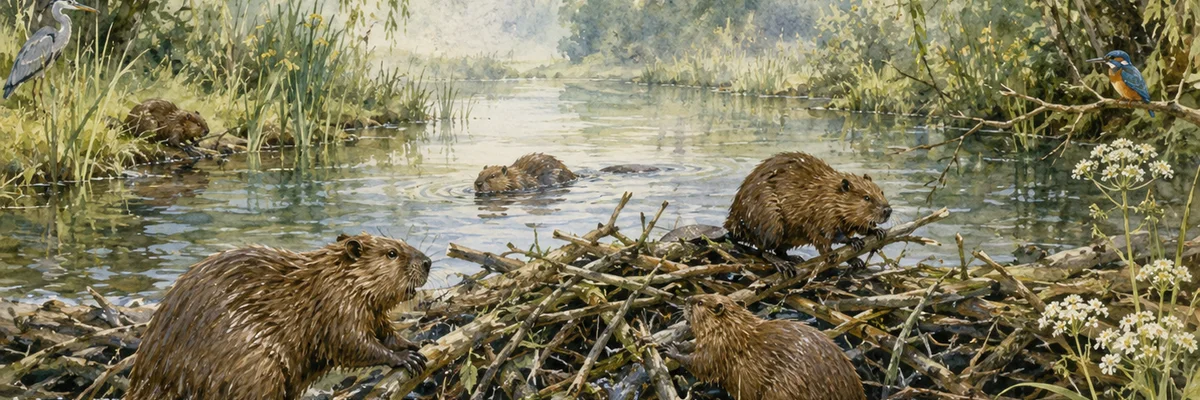
Beavers are back in England
In March 2025, Eurasian beavers were officially released into the wild in England for the first time in centuries. This small mammal transforms wetlands far better than any civil engineering project.
In March 2025, a quiet event marked a turning point in England’s natural history: for the first time in centuries, Eurasian beavers were officially released into the wild — at Purbeck Heath in Dorset — under the auspices of Natural England and the Beaver Trust.
Why does this matter? Because the beaver is one of the few animals capable of reshaping an entire landscape without a public works budget. By building its dams, it slows watercourses, creates wetlands, retains water during droughts and reduces flooding downstream. Within a few years, dried-out meadows transform into habitat mosaics for birds, insects and amphibians.
A study published in Science of the Total Environment in 2024 confirmed this: wetlands created by beavers host significantly higher bat activity than control watercourses — a robust indicator of restored biodiversity.
England was thus joining Scotland and Wales, which had already welcomed these aquatic engineers. This is not ecological nostalgia. It is functional restoration: allowing an animal to do better than we can with concrete what we are trying to do ourselves.
Further reading: The Rewilding Revolution: How Europe Is Bringing Its Territories Back to Life