
Nature as Medicine: What Science Now Measures
Contact with nature is often relegated to 'alternative medicine'. Clinical data tell a different story: 21% less cortisol in 10 to 30 minutes, strengthened immune cells, reduced mortality risk. Here is the state of the evidence.
Nature as Medicine: What Science Now Measures
TL;DR: “Reconnecting with nature” sounds like magazine advice. Clinical research sees it differently: 10 to 30 minutes in a green space reduce cortisol by 21%. Two hours per week is enough to significantly improve perceived health. And the cells that defend your body against cancer increase after a day in the forest. These effects are measured, published in peer-reviewed journals, and reproducible. This article documents the evidence — and its limits.
There is an implicit hierarchy in our relationship to health. On one side, “hard” medicine: molecules, scanners, randomised controlled trials. On the other, what is sometimes called “soft” medicine: walking in the forest, gardening, urban parks. This distinction may be less well-founded than it appears.
Since the 2000s, a body of clinical research has formed around a precise question: what happens, physiologically, when a human being spends time in a natural environment? The answers are expressed in measurable biomarkers, not subjective impressions. And they raise a serious question for health systems that tend to ignore what nature does to the body.
What the Forest Does to Your Physiology
In 2004, the Japanese government launched a national research programme to scientifically document the effects of Shinrin-yoku — “forest bathing” — on human health. Not a wellness initiative: a policy response to accumulating clinical data.
A 2022 review published in Environmental Health and Preventive Medicine by Qing Li (Nippon Medical School, Tokyo) synthesises several decades of measurements. The picture is precise:
- Blood pressure and heart rate: measurable reduction after forest exposure — with a documented preventive effect on hypertension and cardiovascular disease.
- Stress hormones: Shinrin-yoku reduces urinary adrenaline, noradrenaline and salivary cortisol — the standard biomarkers of chronic stress.
- Immunity: increased activity of NK (natural killer) cells — the killer cells of your innate immune system — as well as intracellular levels of anti-cancer proteins. The review explicitly notes a “suggested preventive effect on cancers.”
- Mental health: POMS (Profile of Mood States) tests record lower scores for anxiety, depression, anger, fatigue and confusion, and a higher vigour score.
These are not observational correlations. They are before/after physiological measurements conducted under controlled protocols. The practice has been recognised in preventive medicine in Japan since 2004.
The Minimum Effective Dose: Two Hours a Week
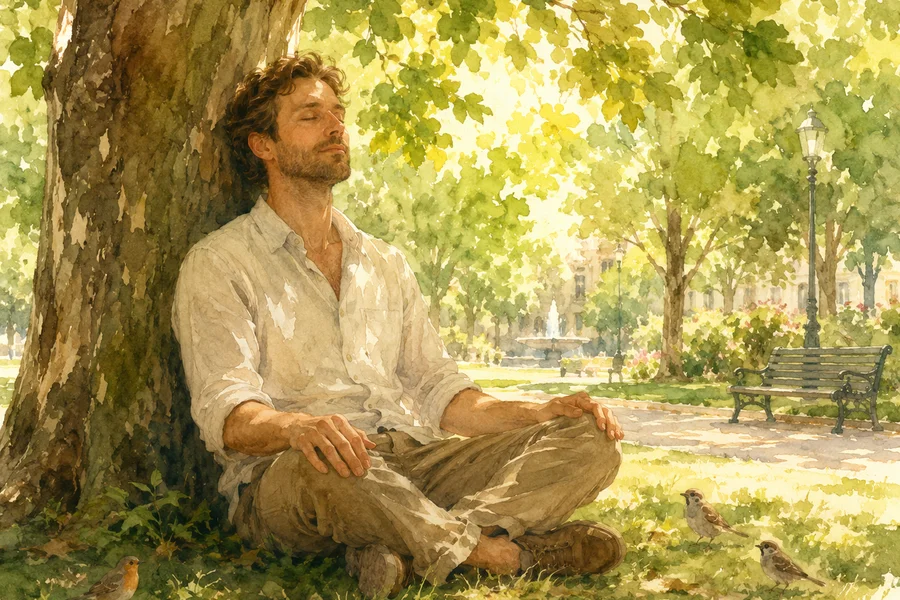
The question that naturally follows is: what dose? Does it require deep forest? A country weekend? Or does an urban park suffice?
A meta-analysis of 78 studies (1990–2020) published in 2025 in Behavioral Sciences by Bettmann, Speelman, Jolley and Casucci establishes quantified thresholds:
- 20 to 30 minutes of nature exposure — even brief, even urban — reduce salivary cortisol by 21% and salivary amylase by 28%. Both biomarkers are direct indicators of sympathetic nervous system activation, i.e. the stress response.
- 10 minutes in an urban green space is enough to improve mood and anxiety.
- 120 minutes per week is the threshold above which people report better perceived health and significantly greater wellbeing. Below it, associations are less robust.
- If an entire urban population reached a minimum of 30 minutes per week outdoors, models estimate up to 7% fewer depression cases and 9% fewer hypertension cases (citing Shanahan et al. 2016).
Two hours per week. Spread however you like. Even on a tree-lined avenue or a neighbourhood square.
Urban Green Spaces: 34 Studies, An Almost Unanimous Finding
Beyond forests, what do we know about green spaces in urban settings? A systematic review by Gianfredi et al. (2021), published in International Journal of Environmental Research and Public Health, examined 34 studies conducted between 2000 and 2020 in OECD countries. The conclusion is direct: almost all included studies found a positive association between urban green spaces and physical and mental health. A few studies found no effect. None found a negative effect.
The results are “almost unanimous” — the term belongs to the authors. That is rare in public health literature.
Walking and Cycling: When Getting Around Becomes Medicine
Another form of daily contact with the outdoors is often undervalued: walking and cycling as modes of transport. The data here are particularly concrete.
WHO Europe (2022) quantifies the preventive effects directly:
- Walking 30 minutes or cycling 20 minutes most days reduces the risk of mortality by at least 10%.
- Those who travel on foot or by bike show roughly 10% lower risk of cardiovascular disease and 30% lower risk of type 2 diabetes.
- Cancer mortality is 30% lower among cycling commuters.
- Physical inactivity causes one million deaths per year in the European Region.
A study published in PNAS in 2025 (Millard-Ball et al., 11,587 cities, 121 countries) quantifies the impact at systemic scale: if every city brought its cycling network up to Copenhagen’s level, simulations indicate global health benefits of $435 billion per year. This is not vague prospecting — it is modelling based on real infrastructure data.
Blue Zones: Nature as Life Infrastructure
Data on the world’s longest-lived people fit the same framework. Researchers Dan Buettner and Sam Skemp spent two decades identifying the common factors in Blue Zones — Sardinia, Okinawa, Ikaria, Loma Linda (California), Nicoya (Costa Rica) — those regions where inhabitants reach 100 ten times more often than average Americans.
The Danish twin study established that only 20% of lifespan is determined by genes. The remaining 80% depends on lifestyle. In Blue Zones, that lifestyle systematically includes natural movement integrated into the built environment — gardening, walking, getting around on foot in villages designed for it. No gyms. An environment that makes outdoor movement inevitable.
The most counter-intuitive finding: knowing your sense of purpose is worth up to seven additional years of life expectancy according to Blue Zone data. This cannot be directly quantified in terms of nature — but natural environments are systematically associated with this sense of purpose in longevity communities.
Honest Limits
These data deserve some nuances:
Access is not equitably distributed. Urban green spaces are unevenly spread. Disadvantaged neighbourhoods often have fewer parks, trees and usable spaces. The documented benefits do not reach everyone equally — and this is an argument for public policy, not against the evidence.
Not all studies are randomised controlled trials. Many rely on observational measurements or before/after studies. Bettmann et al.’s meta-analysis (78 studies) is one of the most robust syntheses available, but causality remains difficult to establish rigorously for some long-term effects.
Nature is not uniform. A park bisected by a noisy road does not offer the same effects as a silent forest. The quality of the natural environment — noise, pollution, sense of safety — moderates the measured effects.
This is not an alternative to medical care. These data fall within the field of preventive medicine and wellbeing. They do not replace medical treatment for established pathologies.
What You Can Do — and What Systems Could Do
For you: the 120-minute-per-week threshold is reached with 17 minutes per day. A walk on the way somewhere, a pause in a park, a detour via a tree-lined avenue. These 17 minutes are measured as sufficient to produce documented physiological effects.
For health systems: the cost of access to nature is negligible compared to the cost of chronic conditions that lower exposure is associated with worsening. WHO Europe puts at one million the number of deaths per year in the European Region attributable to physical inactivity. Some of these deaths are linked to environments designed for cars, not walking.
Nature as medicine is not a metaphor. It’s a reality measurable in biomarkers, mortality rates and avoidable costs. It deserves to be taken seriously in health policy — not as a luxury supplement, but as basic preventive infrastructure.
Sources
- Forest Medicine: Establishment of a New Medical Science — Qing Li, Environmental Health and Preventive Medicine, 2022 — verified 2026-05-03
- Nature Exposure Dose on Mental Illness: Systematic Review and Meta-Analysis — Bettmann et al., Behavioral Sciences, 2025 — verified 2026-05-03
- Association between Urban Greenspace and Health: Systematic Review — Gianfredi et al., IJERPH, 2021 — verified 2026-05-03
- Blue Zones: Lessons From the World’s Longest Lived — Buettner & Skemp, American Journal of Lifestyle Medicine, 2016 — verified 2026-05-03
- Cycling and Walking Reduce Inactivity, Pollution, Save Lives — WHO Europe, June 2022 — verified 2026-05-03
- Global Health and Climate Benefits from Walking and Cycling Infrastructure — Millard-Ball et al., PNAS, 2025 — verified 2026-05-03
See also:
Pass it on
If this article resonated with you, share it with someone around you. In a world where bad news travels fast, it is just as valuable to spread what is going well. Passing on something inspiring is already a form of action.
Comments
Leave a comment
Did this article inspire a thought, a question, or a reaction? Share it below — all comments are reviewed before publication.


