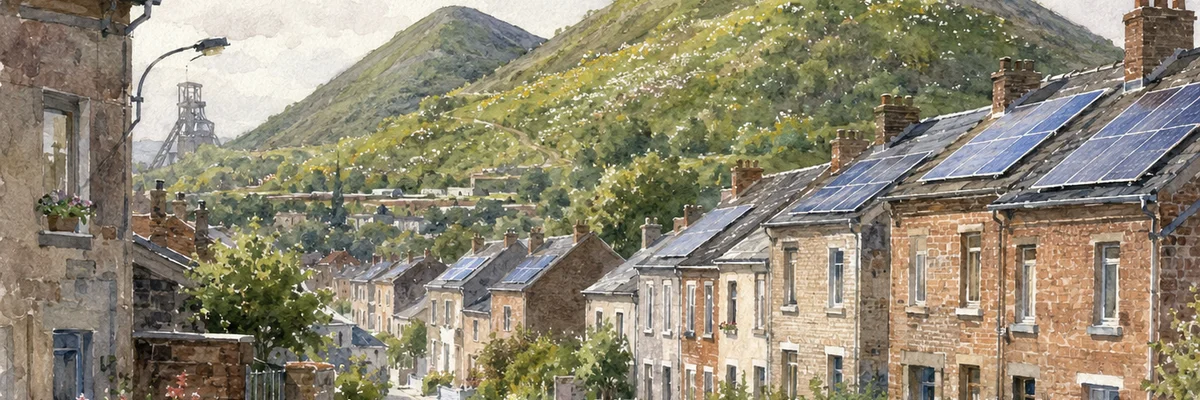
Loos-en-Gohelle: a former mining town covers 90% of its public energy needs from solar
A mining town in Pas-de-Calais marked by unemployment and slag heaps, Loos-en-Gohelle installed 2,600 m² of solar panels on its municipal buildings. Since 2021, these installations cover 90% of public energy needs and generate €50,000 of energy per year.
Loos-en-Gohelle (Pas-de-Calais, 7,000 inhabitants) does not look like a place where you would seek models of ecological transition. Slag heaps dominate the landscape. The unemployment rate exceeds 13%. The industrial memory weighs heavily.
And yet. Since 2021, approximately 2,600 square metres of solar panels installed on around forty municipal buildings cover 90% of the town’s public energy needs. These installations generate around €50,000 of energy per year. The slag heaps — symbols of the coal era — now host a nature reserve.
Mayor Jean-François Caron, re-elected with scores reaching 82% of the vote, has made this transformation a collective project. The town hosts an eco-park for associations, experiments with a local currency in the town centre, and invites citizens to co-fund projects through a participatory scheme.
Loos-en-Gohelle’s unemployment rate remains high. But it is lower than that of Lens (23.6%), Calais (22.8%) or Roubaix (26.4%) — towns with comparable industrial profiles that did not take the same path.
This is not a miracle. It is the result of a coherent municipal policy, maintained across several terms, in a town that had every reason not to believe in it. Loos-en-Gohelle shows that an ecological transition led by and for the inhabitants of a deindustrialised territory is possible — and that its effects can be measured.
Source: Reasons to be Cheerful, February 2026
Further reading: Transition Towns: From Totnes to Loos-en-Gohelle, the Proof Is in the Doing ✿ Coming soon — subscribe to get notified
Comments
Leave a comment
Did this brief inspire a thought, a question, or a reaction? Share it below — all comments are reviewed before publication.