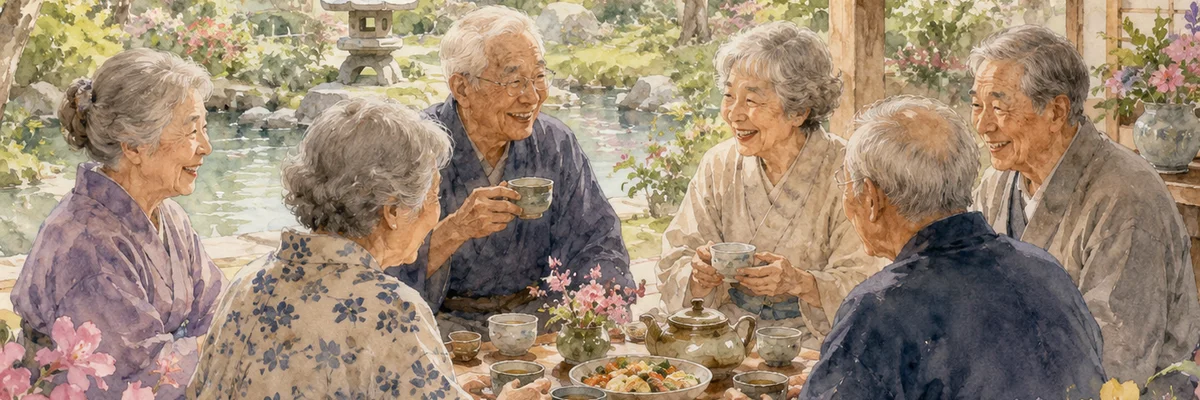
Moai Okinawa: How a Circle of Five Friends Extends Your Life
The moai okinawa tradition: in Okinawa, about half the population participates in a moai — an informal mutual support group, some of which have lasted more than 90 years. Okinawan women live on average 8 years longer than American women. Social connection is probably one of the decisive factors.
In Okinawa, about half the population participates in a moai — a small group of five to ten people who meet regularly, support each other financially in hard times, and move through life together. Some of these groups have lasted more than 90 years.
The principle is simple: you contribute, you share, you age together. If one member loses their job, falls ill or loses a spouse, the group steps in. Security is not abstract — it is embodied in familiar faces.
Blue Zones, the organisation that studies longevity zones around the world, notes that Okinawan women live on average 8 years longer than American women. The moai is identified as one of the probable components of this longevity — alongside diet and physical activity.
Isolation, conversely, reduces life expectancy by up to 8 years according to the same source. This is not an anecdotal correlation: large-scale epidemiological studies place loneliness among the mortality risk factors comparable to smoking.
The moai requires no technology, no infrastructure, no public budget. It demands only one difficult thing: regularity. Showing up. Remaining present for one another, over time. A practice centuries old that looks increasingly like a serious response to a contemporary health crisis.
Further reading: What Blue Zones Teach Us About Longevity ✿ Coming soon — subscribe to get notified
Comments
Leave a comment
Did this brief inspire a thought, a question, or a reaction? Share it below — all comments are reviewed before publication.