
Citizen Microgrids: When a Neighbourhood Generates Its Own Energy
Community microgrids for neighborhoods: in Wildpoldsried, Schoonschip, and through Enercoop, villages and neighbourhoods are producing their own electricity — and reinvesting the revenue locally. Nine thousand communities are already doing this across Europe. Real conditions, documented limits.
Citizen Microgrids: When a Neighbourhood Generates Its Own Energy
TL;DR: Wildpoldsried, Bavaria: 2,600 people, 500% energy surplus, seven million dollars in annual revenue. Schoonschip, Amsterdam: 46 households sharing a single grid connection. In France, 67,000 member-owners collectively own Enercoop. These models work — and they also have their conditions, their fragilities, and their blind spots.
In 1997, the municipal council of Wildpoldsried voted. This small Bavarian village of 2,600 people decided to produce its own energy — not out of idealism, but because local farmers were looking for new income streams. Twenty years later, the village produces five times more energy than it consumes, sells the surplus to the grid, and collects over seven million dollars in annual revenue. The wind turbines were financed by the farmers themselves: payback in ten years, then eighty percent of each dairy farm’s income for the following two decades.
This is not a showcase project. It is an ordinary municipality that made ordinary choices — and documented every step.
Wildpoldsried: The Village That Sells Electricity
The infrastructure deployed at Wildpoldsried reads like a catalogue of existing solutions: five biogas units, biomass digesters, 200 private homes with solar panels, eleven wind turbines with an installed capacity of over twelve megawatts, a biomass district heating network, and three small hydroelectric plants.
By 2011, the village’s carbon footprint had already fallen by 65%. The transition created 140 jobs, attracted over a hundred international delegations per year, and led to a six-million-dollar smart grid project — named IRENE, co-developed with Siemens — to absorb the surplus without destabilising the regional network. That last point is revealing: Wildpoldsried’s very success created a grid stability problem for the local operator. Exporting energy is not a passive flow — it requires regulatory infrastructure.
Amsterdam: 46 Households, One Shared Meter
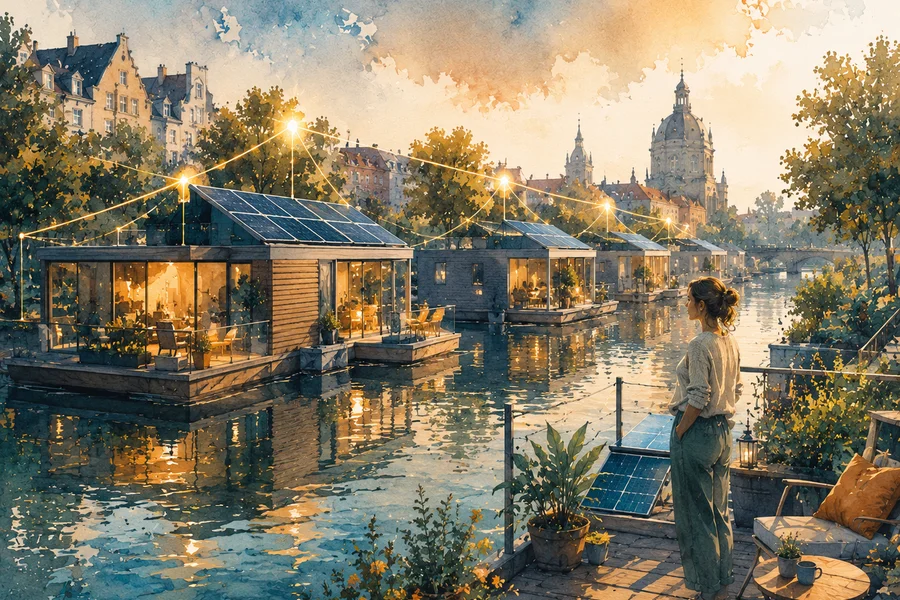
Five hundred kilometres to the north-west, on the Johan van Hasselt canal in Amsterdam Noord, the floating neighbourhood of Schoonschip demonstrates a different model: not a pioneering rural village, but forty-six urban households that pooled their electrical infrastructure.
Thirty floating homes, 516 solar panels, thirty heat pumps, a shared thermal battery — and a single 150 kVA connection to the public grid. Behind that shared meter, an energy management system (STELLAR EMS) optimises in real time who consumes what, at what price, and when to inject power into a virtual power plant aggregated at European scale.
The project has been running since 2018. The Fraunhofer Institute now cites it as a world reference for residential smart grids. It required an experimental exemption from the Dutch Ministry of Economic Affairs — a clear signal of the regulatory barriers this kind of arrangement faces outside pilot projects.
Governance Is Everyone’s Business
Wildpoldsried and Schoonschip illustrate two different logics: local financing by property owners through long-term contracts with the grid operator; and collective private ownership of behind-the-meter infrastructure. In France, a third model has become the reference: the cooperative.
Enercoop now has 67,000 member-owners across thirteen regional cooperatives. Its legal form — SCIC (Société Coopérative d’Intérêt Collectif) — guarantees a simple rule: one person, one vote, whether you are an energy producer, a customer, an employee, or a local authority. Seventy percent of the 600 partner producers are citizen-led projects. The energy mix: 54% wind, 25% solar, 20% hydro.
Alongside the operating cooperative model, Énergie Partagée pools citizen capital to finance the construction of new installations. Since 2010, 7,600 shareholders have invested 51 million euros in 200 labelled projects across France, for an installed capacity of 936.7 MW. The organisation estimates that for every euro invested in a citizen renewable energy project, 2.5 euros benefit the local economy — through taxes, rents, salaries, and services. This figure comes from Énergie Partagée’s own impact calculator and has not yet been independently audited.
A European Movement Already at Work
These examples are not exceptions. The Clean Air Task Force estimates that more than 9,000 energy communities were active in the European Union in 2022, mobilising between €6.2 and €11.3 billion and an installed capacity of 7.2 to 9.9 gigawatts, according to a study cited by the organisation. The federation REScoop.eu represents 2,500 cooperatives and two million citizens across twenty-five countries.
The European Union has set a target of 90 gigawatts of community-installed capacity by 2030 — ten times the current level. In Naples, in the low-income San Giovanni neighbourhood, 166 solar panels have been supplying electricity to twenty families at 25% of the standard utility rate since 2021, financed by public grants.
A study published in Scientific Reports in 2024 (doi: 10.1038/s41598-024-53367-8) estimates that 83% of EU households — approximately 187 million homes — could potentially become active energy citizens, contributing to production, demand response, or storage.
What’s Holding It Back — and What to Watch
The story also has a documented downside.
In Germany, where the movement first took hold, more than half of all renewable electricity was citizen-owned in 2014. By 2021, that share had fallen to one third. The end of twenty-year guaranteed feed-in tariffs changed everything: the auction system that replaced them favoured large financial investors, and an Ecofys analysis found that no cooperative won a photovoltaic auction between 2014 and 2016. Craig Morris, co-author of Energy Democracy, concludes: “In no country have community projects thrived once feed-in tariffs were done away with.”
The European target of creating one energy community per municipality with over 10,000 inhabitants had only reached 27% by January 2025. The directive is non-binding.
There is also a question of social access. The same Scientific Reports study (2024) documents that energy community membership remains “rather exclusive” and typically attracts middle- or high-income households — the initial capital required and the time needed for governance participation act as de facto filters. The Naples example, funded by public grants, offers an alternative path — but one that also depends on an external subsidy to get started.
What to watch: the national transposition of the RED III directive, which creates a legal framework for renewable energy communities, but whose implementation remained incomplete in many member states as of early 2025 according to REScoop.eu. And the post-FiT financing mechanisms that would allow cooperatives to compete on equal terms with large operators.
The citizen microgrid is not a marginal alternative. It is a growing, documented model that works where the regulatory and financial conditions allow it to. Wildpoldsried started with a council vote. Schoonschip started with a regulatory exemption. The question is no longer “is this possible?” — it is “who creates the conditions for it to be?”
Sources
- Wildpoldsried — EnergyTransition.org — verified 2026-05-31
- Wildpoldsried — Wikipedia — verified 2026-05-31
- Schoonschip — Spectral Energy — verified 2026-05-31
- Schoonschip — Fraunhofer ITWM — verified 2026-05-31
- Enercoop — cooperative model — verified 2026-05-31
- Énergie Partagée — €51M invested — verified 2026-05-31
- Énergie Partagée — key figures — verified 2026-05-31
- REScoop.eu — About us — verified 2026-05-31
- REScoop.eu — Citizens Energy Package — verified 2026-05-31
- CATF — Energy Communities EU — verified 2026-05-31
- Clean Energy Wire — decline of citizen energy in Germany — verified 2026-05-31
- IEA — Renewable energy cooperatives in Germany — verified 2026-05-31
- PMC / Scientific Reports — Barriers for energy communities in Europe (2024, doi: 10.1038/s41598-024-53367-8) — verified 2026-05-31
Pass it on
If this article resonated with you, share it with someone around you. In a world where bad news travels fast, it is just as valuable to spread what is going well. Passing on something inspiring is already a form of action.
Comments
Leave a comment
Did this article inspire a thought, a question, or a reaction? Share it below — all comments are reviewed before publication.


