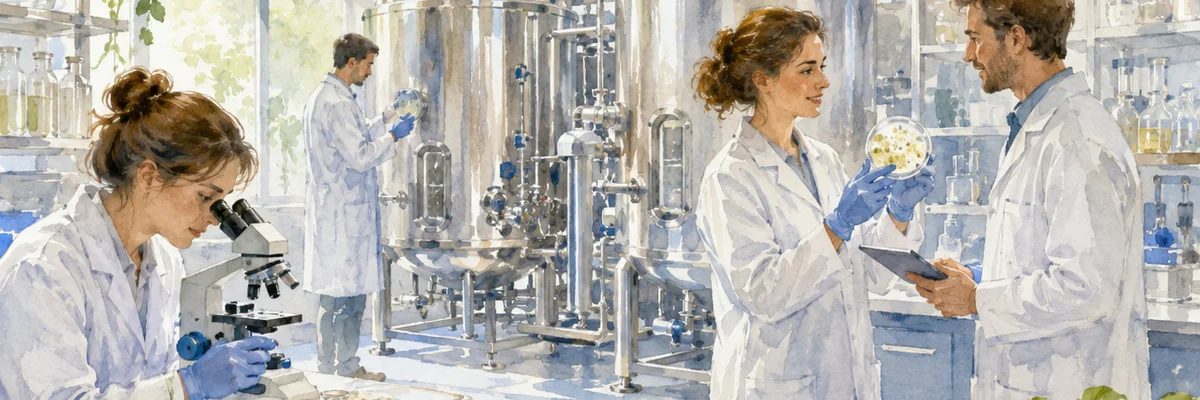
Precision fermentation: proteins without animals, with 91 to 97% fewer greenhouse gas emissions
An ISO 14067-certified lifecycle analysis shows that proteins produced by precision fermentation generate 91 to 97% fewer greenhouse gas emissions than conventional dairy proteins, with 96 to 99% less water consumption.
Precision fermentation uses programmed microorganisms to produce proteins identical to those in milk — without cows, without livestock farming, without the associated agricultural land use. A lifecycle analysis published by Perfect Day in 2021, certified to the ISO 14067 standard and reviewed by an independent panel of three experts, quantifies the gap.
Compared to conventional dairy proteins, proteins produced this way generate 91 to 97% fewer greenhouse gas emissions. Energy consumption falls by 29 to 60%. The blue water footprint (fresh water consumed and not returned) decreases by 96 to 99%.
These wide ranges reflect different scenarios — they do not hide any uncertainty about the direction. In every scenario tested, precision fermentation is markedly less resource-intensive.
One limitation must be noted: the study was conducted using the American electricity grid, which remains largely powered by fossil fuels. As electricity grids decarbonise — in Europe in particular — the climate advantage of this technology grows mechanically.
Precision fermentation is not presented as a universal solution. It is a technology currently moving into commercial deployment, with production costs that remain high. But the signal is clear: producing complex proteins without going through the animal kingdom is no longer a theoretical hypothesis. It is an industrial reality whose environmental footprint is now measured with rigour.
Source: Perfect Day, Life Cycle Assessment, 2021 (ISO 14067)
Further reading: Precision Fermentation Is Already in Your Cheese
Comments
Leave a comment
Did this brief inspire a thought, a question, or a reaction? Share it below — all comments are reviewed before publication.