Precision Fermentation Is Already in Your Cheese
80% of the world's rennet has been produced without animals since 1990. The same technology promises dairy proteins with 91–97% fewer emissions — with important nuances on costs, European regulation and patent concentration.
Precision Fermentation Is Already in Your Cheese
TL;DR: Precision fermentation has been producing 80% of the world’s rennet since 1990 and insulin since 1982. Applied to dairy proteins, it shows between 91 and 97% fewer CO₂ emissions than conventional supply chains — but these figures come mostly from company-produced LCAs, and cost remains a major challenge. The prospects are real; they deserve to be read without greenwashing.
When you eat a piece of comté or cheddar, there’s a good chance the rennet that coagulated your cheese didn’t come from a calf’s stomach. Since 1990, 80% of the world’s rennet has been produced by precision fermentation — a microscopic fungus produces the same enzymatic protein, molecularly identical to the animal original. You may never have known. That’s because this technology, when it works, is invisible.
Go back to 1982. A single pound of insulin then required extracting the glands of 23,500 animals — 8,000 pounds of organs to treat just 750 patients. That same year, the first human insulin produced by a modified bacterium, E. coli, reached the market. Since then, precision fermentation has been supplying the world with insulin, vitamin B12, amino acids and food enzymes — quietly, without scandal.
This context changes how to read current announcements about “animal-free” dairy proteins or “slaughterhouse-free” meat. Precision fermentation is not a rupture from nowhere: it’s the application of an industrial logic proven over 40 years to new substrates.
What Precision Fermentation Actually Does
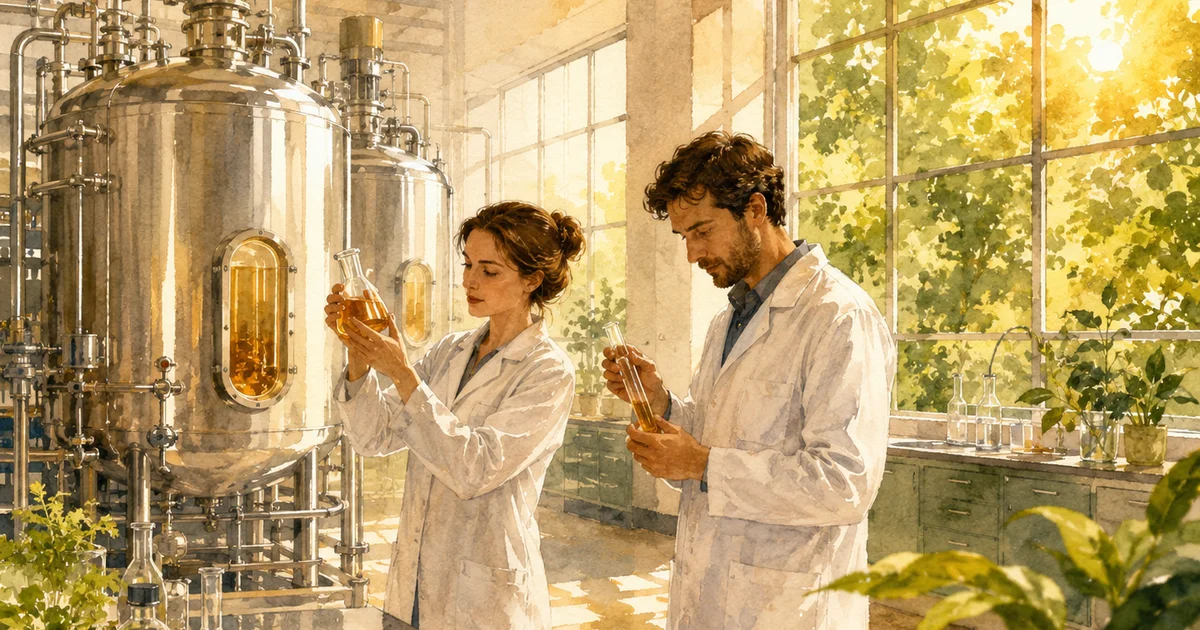
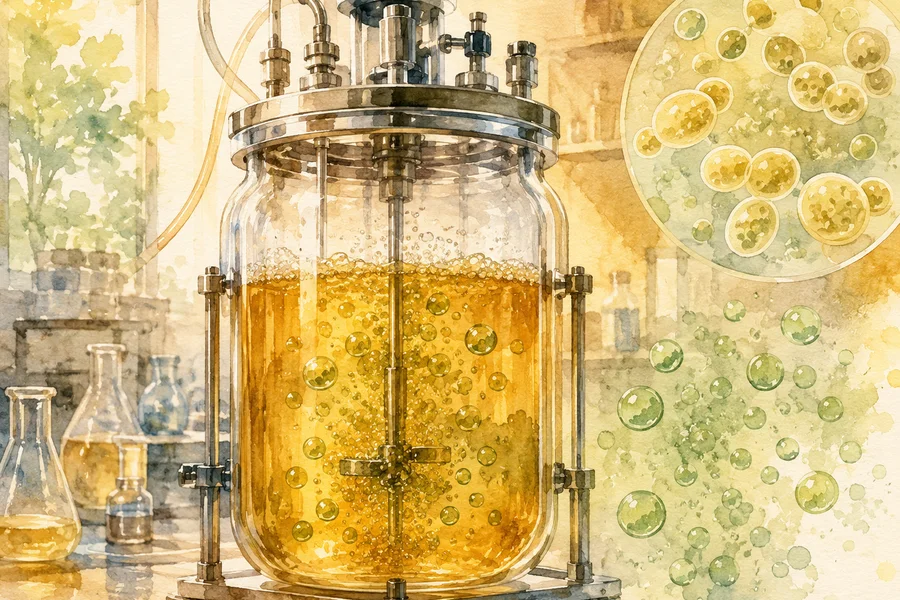
The principle is simple to describe, complex to industrialise. A genetic sequence coding for a target protein is inserted into a micro-organism — fungus, bacterium, algae. The yeast or fungus becomes a biological factory: it produces this specific protein in a fermentation tank, in large quantities and under controlled conditions. The protein is then extracted and purified. The micro-organism itself does not end up in the final product.
Here lies a common misunderstanding: the micro-organism used is indeed genetically modified. But the protein it produces — whether β-lactoglobulin (whey protein) or ovalbumin (egg white protein) — is identical to the animal version. It contains no modified DNA. It’s not the protein that is transgenic: it’s the manufacturing tool.
This distinction matters, but it does not close the debate. The Non-GMO Project argues that companies are not transparent enough about this process, and that the absence of mandatory labelling in the US — legal because the final product contains no detectable modified DNA — constitutes a trust blind spot. It’s an honest argument. One can think that the protein is safe and that consumers deserve clear information about how it was produced.
The Environmental Footprint: Real Numbers, Critical Reading
The environmental data circulate widely. They deserve to be clarified.
Perfect Day, the pioneering Californian company, published a revised ISO-certified life cycle analysis in 2021: its animal-free whey protein shows 91–97% fewer GHG emissions, 29–60% less energy, and 96–99% less water than conventional whey. Bon Vivant, Europe’s first PF company based in France, reports comparable results: 96% less CO₂, 99% less water, 92% less land.
A peer-reviewed study from Imperial College London, published in February 2026, confirms a land footprint reduction of the same order. Warren et al. estimate that replacing 100% of UK cow’s milk production with precision fermentation milk would free up 4,294,000 hectares of land by 2050 — an area larger than the Netherlands.
These figures matter. They are not the whole story.
An independent critical review (Behm et al. 2022) shows that the carbon footprint of precision fermentation varies considerably depending on two factors: the electricity source (fermentation powered by coal can equal or exceed conventional supply chains) and the sugar feedstock (glucose or sucrose, whose agricultural production has its own carbon balance). Within this wide range, the footprint spans 5.5 to 17.6 tonnes of CO₂e per tonne of protein — compared to 10 tonnes for conventional milk. Precision fermentation is not automatically green: it is if the electricity is decarbonised.
Furthermore, the Vegetarian Resource Group highlights a methodological bias often overlooked: in each Perfect Day fermentation batch, the target protein represents only 21.7% of the biomass produced. The remaining 78.3% are non-food co-products. Company life cycle analyses sometimes allocate environmental burdens favourably to the flagship product. This is not fraud — it’s a limitation to know when reading these figures with discernment.
The Pioneers: Who Is Building This Market
The sector remains dominated by a handful of players, mainly American and Israeli, with a few promising European exceptions.
Perfect Day (California) obtained the first FDA GRAS status for a dairy protein derived from precision fermentation in 2020. Its proteins now appear in Brave Robot ice cream, Bored Cow drink and Modern Kitchen cream cheese. The company has raised more than $800 million and holds more than 25 patent families.
Remilk (Israel) obtained US GRAS status in 2022, then the historic approval of the Israeli Ministry of Health in April 2023 — a world first for a dairy protein from precision fermentation. The company already produces at industrial volumes in several countries, having raised more than $130 million.
Bon Vivant (France) is Europe’s first B2B supplier of PF dairy proteins. Its positioning — ingredient supplier to food industry players, not a consumer brand — illustrates a strategy common in the sector: feeding the transition of existing players rather than frontally replacing them.
Impossible Foods (California) uses precision fermentation to produce soy leghemoglobin — the molecule that gives its plant burger the appearance and taste of meat. The EFSA issued a positive safety opinion in August 2024, with approvals already obtained in the US, Canada, Australia, New Zealand and Singapore.
Solar Foods (Finland) pushes the logic further: its Solein protein is produced from CO₂ and hydrogen from water electrolysis — no sugar, no agricultural land. Their first industrial production unit is operational in Finland, with higher commercial capacity already planned.
Regulation: Two Speeds
In the United States, the path is mapped. The FDA’s GRAS status constitutes a well-tested and predictable framework: Perfect Day obtained it in 2020, Remilk in 2022. These “no questions” letters mean the FDA raises no objection to using these proteins in food.
In Europe, the situation is different. The “Novel Food” regulation requires full assessment by EFSA before any commercial sale. Perfect Day submitted its dossier in 2022 — it was still under review in early 2026. Remilk submitted in 2023, received a procedural inadmissibility letter and resubmitted. EFSA requires five analytical samples where other agencies ask for three — a costly logistical constraint for pre-commercial start-ups.
Concrete result: in July 2026, no dairy protein from precision fermentation is yet approved for sale in Europe. This is not necessarily a refusal — it’s the slowness of a precautionary system designed for an established food industry, not for radically new entrants.
What Consumers Think
A study conducted by Formo Bio (Berlin) and Singapore Management University on 3,006 participants in Germany, Singapore and the United States shows that 51–61% of participants would be willing to try a product made from egg proteins derived from precision fermentation. Vegetarians and vegans show the greatest enthusiasm. In Germany, the primary driver is animal welfare; in Singapore and the US, it’s health; in all three countries, curiosity plays a major role.
The identified barriers are price, the perception of “artificiality” and unfamiliarity with the process. The last point is structural: when consumers understand that the rennet in their cheese has already been working on this same principle since 1990, acceptability tends to rise.
Honest Limits: Costs, Scale, Patents
Cost remains a major obstacle. Synthesis Capital states it directly: “It is today much more expensive to produce a kilogram of protein via precision fermentation than via a cow.” Glucose or sucrose represents more than 50% of the cost of production, and extraction-purification steps can absorb up to 85% of costs for high-end biologics. Price parity with conventional milk has not been achieved for commodity proteins. For high-value proteins such as lactoferrin, precision fermentation is, however, already competitive.
Infrastructure is a bottleneck. Building a large-scale fermentation plant costs hundreds of millions of dollars. “We massively need infrastructure — who activates it, how do we get there?” summarises Shannon Hall of Pow.Bio. In Europe, the question is even more open than in the US.
Patent concentration is a systemic risk. A Stanford/One Earth study (2023) shows that Impossible Foods alone holds more than 50% of plant-based meat patents in the US and EU. In September 2024, after two and a half years of proceedings, Motif FoodWorks — one of the best-funded players in the sector — was forced to close following an intellectual property lawsuit by Impossible Foods. The number of patent filings tripled between 2018 and 2022. A technology that promises to democratise access to protein can also become an oligopoly if public policy does not respond.
On the “GMO or not” question, the honest answer is twofold: yes, the production micro-organism is genetically modified; no, the final protein contains no modified DNA — it is chemically identical to the animal version. This distinction must not serve to sidestep the transparency question: consumers have the right to know how their food is produced, even when that process is legally outside the scope of GMO labelling.
What This Changes — and What It Won’t Change Alone
Global investment in fermented proteins exceeded €5 billion between 2015 and 2024, including more than €1 billion in Europe. The market is projected at €108–162 billion by 2050 depending on climate scenarios.
These figures must not obscure what matters most: precision fermentation is not a solution in itself. It will not answer the question of global food supply if it remains reserved for premium markets. It will not erase food inequalities if its patents remain concentrated in a few hands. And it will not substitute for the systemic transformations needed — reducing waste, valorising local plant proteins, evolving consumption patterns — through a simple change of ingredient.
What it does offer, however, is something rare: a technology already mature, already proven in other domains for forty years, whose environmental benefits are measurable, whose risks are identifiable, and whose European players are positioning themselves. Not a promise — a trajectory. With its learning curves, its regulatory bottlenecks, and its governance questions still open.
The rennet in your comté opened the way in 1990. What comes next depends on what you, as a citizen and as a decision-maker, choose to make of it.
Sources
- Warren et al. — UK land use implications of precision fermentation (Frontiers 2026) — verified 2026-05-07
- Green Queen — Animal-Free Milk LCAs (Perfect Day + Bon Vivant) — verified 2026-05-07
- Sustainable Nutrition Initiative — Behm et al. 2022 critical review — verified 2026-05-07
- GFI Europe — History of precision fermentation — verified 2026-05-07
- FoodUnfolded — Precision Fermentation: Past, Present and Future Promise — verified 2026-05-07
- Remilk — Israeli MoH approval 2023 — verified 2026-05-07
- Vegconomist — EFSA positive opinion on Impossible Foods heme (Aug. 2024) — verified 2026-05-07
- FoodNavigator — Precision fermentation dairy seeks EFSA approval — verified 2026-05-07
- Frontiers 2023 — Consumer acceptance of PF-made egg (n=3,006) — verified 2026-05-07
- Synthesis Capital — Pathways to cost parity — verified 2026-05-07
- FoodNavigator USA — Scale-up struggles 2026 — verified 2026-05-07
- Stanford / One Earth 2023 — Patent concentration in alt-protein — verified 2026-05-07
- GMWatch — Motif FoodWorks closure 2024 — verified 2026-05-07
- Spruson & Ferguson — Patent boom in precision fermentation 2025 — verified 2026-05-07
- ProVeg International — Unlocking the potential of precision fermentation in Europe — verified 2026-05-07
- VRG Blog — LCA critique of Perfect Day (21.7% biomass) — verified 2026-05-07
- RethinkX — “PF products are not GMOs” — verified 2026-05-07
- Food Dive / Non-GMO Project — transparency critique — verified 2026-05-07
- Perfect Day — GRAS regulatory overview — verified 2026-05-07
Further reading: Precision fermentation: proteins without animals, with 91 to 97% fewer greenhouse gas emissions
Pass it on
If this article resonated with you, share it with someone around you. In a world where bad news travels fast, it is just as valuable to spread what is going well. Passing on something inspiring is already a form of action.
Comments
Leave a comment
Did this article inspire a thought, a question, or a reaction? Share it below — all comments are reviewed before publication.


