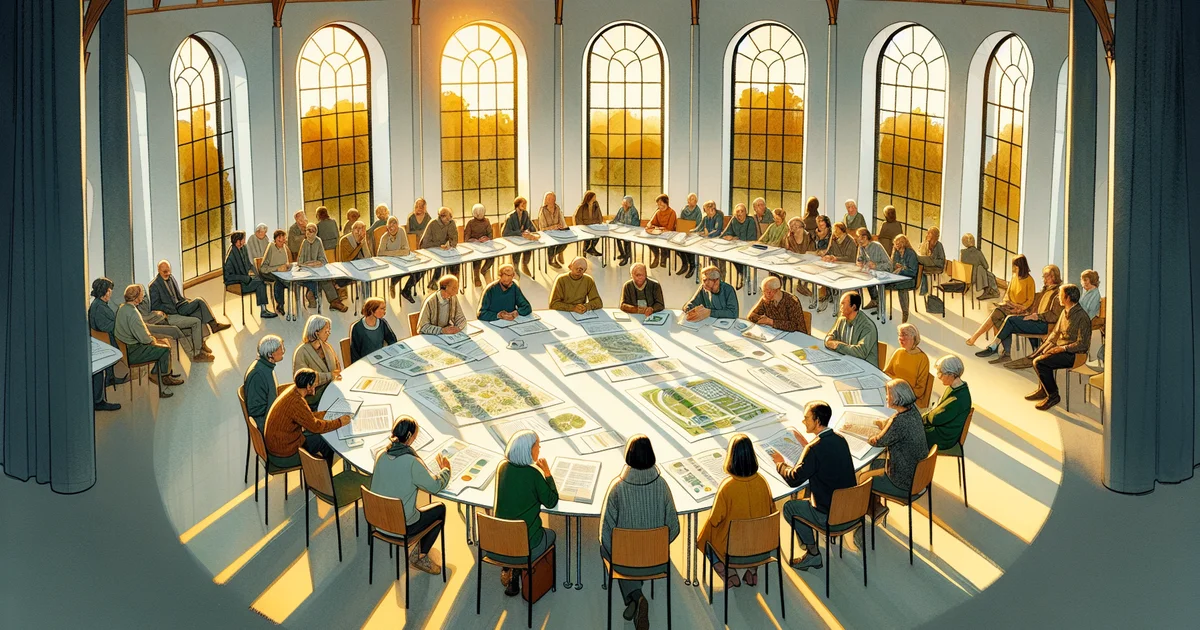
The Citizens' Assembly: How Ordinary People Change Constitutions
Selected like jurors, 99 Irish citizens made possible what politicians had avoided for decades. Deliberative democracy works — here is the evidence, and its real limits.
The Citizens’ Assembly: How Ordinary People Change Constitutions
TL;DR: Some political questions remain frozen for decades — too complex, too sensitive for elected officials subject to electoral pressures to resolve. Experiments in Ireland, France and Belgium show that a group of ordinary citizens, selected by sortition like jurors and well-informed, can deliberate seriously on these questions and produce legitimate recommendations. It is a method that works — and one that also reveals its real limits.
Some political questions seem unsolvable — not for lack of solutions, but because they touch on complex issues or values that elected officials, subject to electoral pressures, are unwilling to arbitrate. They remain frozen for decades.
In Ireland, France, Belgium and elsewhere, a response has been developing for twenty years: hand deliberation to ordinary citizens, selected by sortition like jurors. Informed in a balanced way, free from re-election pressure, they produce recommendations that political leadership did not dare formulate.
That was not a miracle. It was a method.
Sortition: an old idea making a comeback
Ancient Athens governed by sortition. Our courts still function with popular juries — because it has been observed that a group of ordinary citizens, well-informed and deliberating together, often makes better decisions than isolated experts or elected officials subject to electoral pressures.
The modern citizens’ assembly revives this principle. A representative sample of society is recruited — by age, gender, region, social class — not to represent interests, but to represent people. Over several weeks or months, these citizens receive conflicting information, hear from experts and stakeholders, debate in small groups guided by professional facilitators. Then they deliberate, on their own.
No lobbyists. No re-election pressure. Just ordinary people thinking seriously about a difficult question.
Ireland: unlocking in five months what politics had avoided for forty years
The Irish Citizens’ Assembly — 99 members selected by sortition, stratified by sex, age, geography and social class — met from November 2016 to April 2017 around a question that Irish political leadership had been avoiding for decades: should the Eighth Amendment to the constitution on abortion be changed?
The method was rigorous: 12,000 public submissions received and examined. Personal testimonies from directly affected women. Medical, legal, ethical presentations — both for and against reform. Small-group facilitated discussions, with strict rules to ensure every voice was heard.
At the end of the deliberations, 64% of members recommended a constitutional amendment. A referendum was held in May 2018 — the question that political parties had avoided for 35 years was settled through direct democratic process.
A study published in Frontiers in Political Science notes that 66% of voters had heard of the citizens’ assembly during the campaign, and that this awareness significantly shaped their informed engagement. The assembly did not merely deliberate — it informed the public debate.
Decades of political paralysis, unlocked by the deliberation of ordinary citizens.
Ireland, act II: 99 citizens confronting biodiversity collapse
The Irish model did not stop there. From May 2022 to January 2023, a new assembly was convened — this time on biodiversity loss. 99 citizens selected by sortition, meeting seven times, made it the world’s first citizens’ assembly dedicated to this subject.
The result: 159 recommendations — covering agriculture, wetlands, forests and the marine environment. And a strong signal: 83% of members voted in favour of a referendum to enshrine the rights of nature in the Irish constitution.
This case illustrates the model’s versatility. The issue was not a moral controversy: it was a systemic crisis where the science is clear but political action stalls. Ordinary citizens, with no electoral agenda, were able to work through this complexity and formulate proposals that few parliaments would have produced on their own.
The final report was submitted to the Irish Parliament in April 2023. The ultimate decision still lies with elected officials — that is the model’s persistent limit. But the democratic legitimacy to act is now squarely in place.
France: the process worked; the political follow-through less so
In 2019, France launched the Citizens’ Convention on Climate. 150 citizens, representative of French society, received a clear mandate: propose measures to reduce greenhouse gas emissions by 40% by 2030, “in a spirit of social justice.”
From October 2019 to June 2020, organised around five themes — housing, work and production, transport, food, consumption — the Convention produced 149 concrete proposals. The President endorsed 146 of them.
Up to that point, the model held.
What followed is more nuanced. Around 20% of the proposals were transposed faithfully into law. Around 40% were adopted in modified form — sometimes diluted, sometimes integrated into other legislation. The rest remain pending or abandoned.
This track record does not invalidate the method. It reveals its real limit: a citizens’ assembly can produce a legitimate mandate and rigorous proposals. It cannot compel elected officials to implement them.
Deliberation works. Implementation depends on political will.
That is an essential distinction. To present this as either a complete success or a complete failure would be equally inaccurate.
The four conditions that make the difference
Not all citizens’ assemblies are equal. Researchers who study this model identify four determining conditions:
1. A clear mandate. The assembly must know what it is expected to produce and what will be done with the result. A vague mission produces vague deliberation.
2. Genuine diversity in the sample. Stratification by age, gender, geography, social class — no co-optation, no pre-selected activists. In Ireland, successive assemblies have consistently included people with very different initial positions on the questions examined. That is precisely what made their deliberations credible in the eyes of the public.
3. Structured deliberation. High-quality information presented in a balanced way, sufficient time, small groups facilitated by professionals. Studies show that ordinary citizens, well-informed, produce far more nuanced reasoning than the media assumes.
4. An institutional commitment to follow-through. This is the weak link. When governments publicly commit in advance to presenting conclusions to parliament or in a referendum, follow-through is significantly better. Ireland did this. France committed to it in part — and the result is proportional to that commitment.
The real critique: not the process, but what comes after
The main criticism directed at citizens’ assemblies is not that they deliberate poorly — studies show they often deliberate better than expected. It is that their recommendations can be ignored.
That is a legitimate criticism. And it is a political criticism, not a criticism of the deliberative model itself.
The question therefore is not “does it work?” but “how do we ensure it leads somewhere?” Several approaches exist: formally tying the assembly to a referendum, giving it a right of legislative initiative, or at minimum requiring a publicly reasoned response from parliament to each recommendation.
Experiments along these lines are multiplying — in Belgium, Scotland, Australia — with increasingly robust institutional frameworks. Citizens’ assemblies are moving out of the experimental phase and into normal democratic practice in some systems.
What changes, even beyond direct outcomes
There is an often-underestimated effect: what participants themselves experience.
People who take part in a citizens’ assembly generally come out of the experience with a heightened sense of political agency. People who had never participated in any form of governance discover that they can understand complex questions, contribute to their resolution, and trust other citizens to do the same.
This is not anecdotal. It may be the most durable result: not merely a constitutional reform, but the rebuilding of trust between citizens and institutions — through the proof that citizens themselves can be trusted.
In a context where distrust of political elites is reaching record highs in most Western democracies, that is no small thing.
What you can do
- Read the final report of the Citizens’ Convention on Climate — the 149 proposals remain a solid reference, regardless of their implementation rate.
- Follow the Sortition Foundation (UK) or the G1000 (Belgium) to understand how these practices are developing at the European level.
- Support participatory democracy initiatives in your local area — citizens’ councils, participatory budgets, public consultations.
- Apply if you are ever selected by sortition: studies show that ordinary people take it very seriously, and that participation transforms them lastingly.
The citizens’ assembly does not replace representative democracy. It complements it, on the questions where elected officials are structurally unable to move forward. And it proves, again and again, that ordinary people are up to the task when they are trusted.
Sources
- Citizens’ Assemblies for Referendums and Constitutional Reforms: Is There an “Irish Model” for Deliberative Democracy? — Dimitri Courant, Frontiers in Political Science, 8 January 2021 — verified 2026-05-02
- Bridging representative and direct democracy? Ireland’s Citizens’ Assemblies — Hansard Society — verified 2026-05-02
- Final Report — Citizens’ Convention on Climate — official CCC website — verified 2026-05-02
- Citizens’ Assembly on Biodiversity Loss — 2023 report — Irish Citizens’ Assembly — verified 2026-05-27
Pass it on
If this article resonated with you, share it with someone around you. In a world where bad news travels fast, it is just as valuable to spread what is going well. Passing on something inspiring is already a form of action.
Comments
Leave a comment
Did this article inspire a thought, a question, or a reaction? Share it below — all comments are reviewed before publication.


