When Residents Control Public Budgets, the Most Vulnerable Benefit Most
In 1989, Porto Alegre handed part of its budget to residents. Within ten years: drinking water in 98% of homes, health spending tripled, infant mortality down. The model has spread to 7,000–11,500 cities. The data contradict the received wisdom.
When Residents Control Public Budgets, the Most Vulnerable Benefit Most
TL;DR: In 1989, Porto Alegre, Brazil, invented participatory budgeting: residents — including the poorest — directly decided how part of the city’s spending would be allocated. Within ten years: running water in 98% of homes (up from 75%), health and education budgets tripled, infant mortality down. The model has spread to 7,000–11,500 cities worldwide. Paris, New York, and Scotland have adopted it. The limits are real — but the data contradict the assumption that citizens cannot manage public money.
In 1989, Porto Alegre was a Brazilian city of 1.2 million people. In the outlying neighbourhoods, thousands of families had no access to running water. The roads were unpaved. Public money existed — but it was not reaching the places where it was needed most.
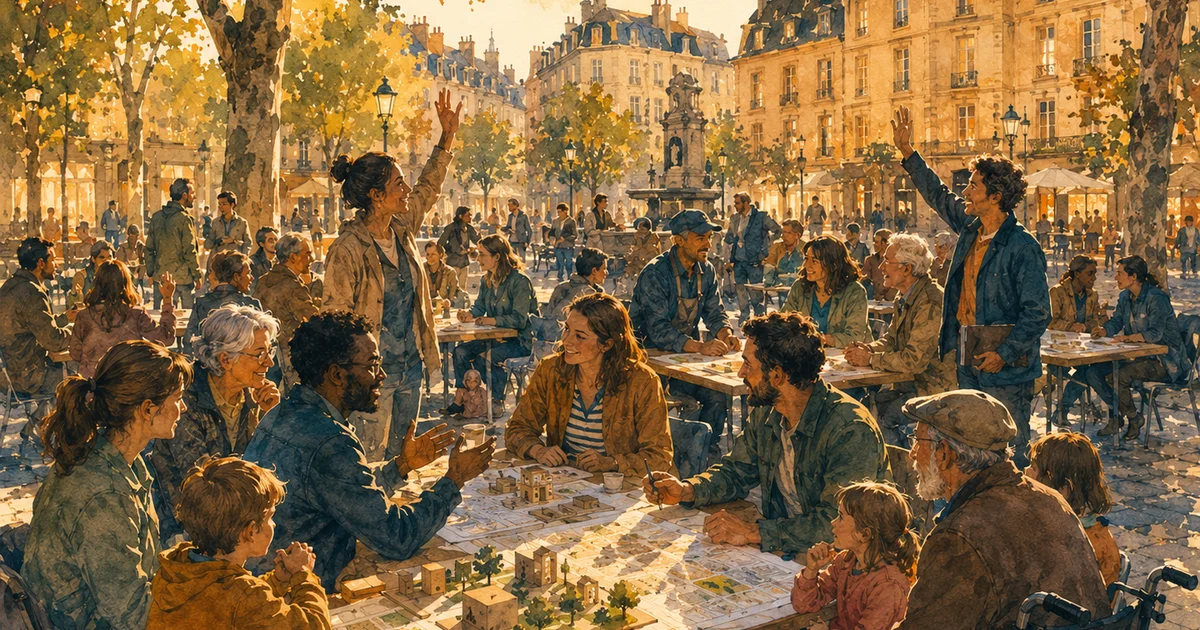
The newly elected mayor Olívio Dutra made an unusual decision: he invited residents to decide for themselves how part of the municipal budget would be spent. Not through a representative vote, but at neighbourhood assemblies where any citizen could speak, set priorities, and make decisions. This was the birth of participatory budgeting (PB).
What Porto Alegre Proved in Ten Years
The results, documented by the World Resources Institute in 2018, are striking. From 1988 to 1997, connections to the water and sewage network rose from 75% to 98% of households. The share of the budget devoted to health and education went from 13% (1985) to nearly 40% (1996). The number of schools quadrupled since 1986.
And infant mortality fell by roughly 20%. A 2014 econometric study published in World Development — Sónia Gonçalves, covering Brazilian municipalities — confirmed the mechanism: cities that adopted PB allocated more to sanitary infrastructure and health, and recorded a measurable reduction in infant mortality.
The logic is strikingly coherent: when the poorest residents decide the priorities, they choose what they need most — water, healthcare, schools. Not ornamental fountains.
7,000 Cities, or 11,500? Either Way, the Scale Is There
Since Porto Alegre, the model has travelled. The Participatory Budgeting Project counts “more than 7,000 cities worldwide.” Wikipedia, drawing on 2024 data, cites more than 11,500 PB processes globally — the difference comes down to distinct counting methodologies. Both figures point to a phenomenon that has long since outgrown its Brazilian origins.
In New York, since 2012, residents have directed $210 million across 706 projects: school renovations, park improvements, library equipment. In 2018, 99,250 residents — from age 11 — took part. It is the largest local civic engagement programme in the United States.
In Paris, since 2014, the city has received 23,912 ideas, put 1,345 to a vote, and completed more than 3,500 projects.
In Scotland, the national government made an institutional commitment: at least 1% of local authority budgets will be subject to PB. Within two years, 97,000 citizens had participated in PB processes. In 2017/18 alone, £3.4 million was distributed and 1,069 projects funded.
Why It Works: The Mechanics of Attention
What distinguishes PB from a simple consultation is the nature of the power transferred. This is not about giving your opinion — it is about making decisions. Participants work with real budget envelopes, weigh competing projects, and live with the consequences of their choices.
The Open Government Partnership synthesises the documented effects: participants “feel empowered, support democracy, perceive government as more effective, and better understand budget processes.” The transparency that PB imposes also tends to reduce corruption and clientelism — factors that, in Porto Alegre, had historically diverted funds away from the most deprived neighbourhoods.
The Honest Limits
Porto Alegre’s own history is a warning. In 2017, after twenty-eight years of existence, the city suspended its PB process when municipal political support changed hands. Without sustained political commitment, a PB can be dismantled overnight.
Other verified limitations:
- Often modest sums: in most cities, PB covers only a fraction of the total budget. With too few resources, changes remain marginal (OGP 2017).
- Uneven participation: in Germany, some processes have seen only 0.1% of residents engage; in Chicago between 2012 and 2014, between 1 and 3%. Without active facilitation and inclusion infrastructure, the most marginalised people remain absent.
- Capture risk: organised groups can dominate assemblies at the expense of the most vulnerable citizens — the opposite of the intended effect.
- Geographically concentrated evidence: the BMC Public Health systematic review (2018) examined 37 studies from 1,458 identified references. The majority concerned South America. Positive results are robust for Brazil; outside that context, rigorous evaluations remain rare.
What You Can Do
Participatory budgeting is not reserved for large cities. Municipalities of a few thousand residents have implemented it. Across Europe, hundreds of local authorities are experimenting with similar mechanisms.
Three concrete entry points:
- Check whether your local authority runs a participatory budget — many municipalities have a dedicated page or a civic participation portal.
- If yes, participate: the next assemblies are usually announced on the town’s website or through local associations.
- If no, ask the question: organisations such as the Open Government Partnership support elected officials and citizens in setting up participatory processes.
Porto Alegre showed that a city can decide to change course — and that citizens, when given real power, often choose what technocrats should have prioritised long ago.
Further reading:
- Porto Alegre: when residents decide how their city is built
- Porto Alegre, 1989: When Residents Decided Where Public Money Went ✿ Coming soon — subscribe to get notified
- Digital Democracy: When Citizens Co-Write the Laws ✿ Coming soon — subscribe to get notified
Sources
- World Resources Institute — Porto Alegre: Participatory Budgeting and the Challenge of Sustaining Transformative Change — verified 2026-05-03
- Gonçalves S. (2014). The Effects of Participatory Budgeting on Municipal Expenditures and Infant Mortality in Brazil — World Development, IDEAS/RePEC — verified 2026-05-03
- Participatory Budgeting Project — About PB — verified 2026-05-03
- Participatory Budgeting Project — Participatory Budgeting in NYC — verified 2026-05-03
- Ville de Paris — Budget Participatif : 10 ans de réalisations — verified 2026-05-03
- PB Scotland — 97,000 voters: Community Choices 2017/18 — verified 2026-05-03
- gov.scot — Participatory budgeting — verified 2026-05-03
- Open Government Partnership — Participatory Budgeting: Does Evidence Match Enthusiasm? — verified 2026-05-03
- Campbell M et al. (2018). The impact of participatory budgeting on health and wellbeing: a scoping review — BMC Public Health — verified 2026-05-03
- Wikipedia — Participatory budgeting — verified 2026-05-03
Pass it on
If this article resonated with you, share it with someone around you. In a world where bad news travels fast, it is just as valuable to spread what is going well. Passing on something inspiring is already a form of action.
Comments
Leave a comment
Did this article inspire a thought, a question, or a reaction? Share it below — all comments are reviewed before publication.


